Opening Doors, Expanding Care: Supporting Community Seniors with Long-Term Care Services
Jane Smith* was struggling to care for her husband Joe* at home as his Alzheimer’s disease progressed. Helping him to shower had become dangerous, and his isolation and moods were worsening.
That changed when Joe began attending a local long-term care home through a new government-funded Community Access to Long-Term Care (CALTC) program. He now receives help with bathing and medication and participates socially in adult day program activities. Joe says he feels like a new man, and his wife agrees. The program has also given her much-needed respite.
In the province of Ontario, Canada, more than 50,000 people are on the wait list for long-term care. With a rapidly increasing population over 80, there is an urgent need to make better use of the expertise and resources across health systems to provide seniors’ care. As part of this, efforts are underway to broaden the traditional role of long-term care homes.
In Ontario, long-term care is part of the publicly funded health system. Residents with significant care needs live in LTC homes because they need 24/7 nursing care and support. New provincial investments and programs are supporting a variety of approaches to extending LTC supports into the community, from offering services and day programs within long-term care homes to providing outreach and helping older adults navigate services.
In 2025, the Ontario government launched the CALTC pilot program, initially funding three sites to provide a wide range of services to older adults living at home who are on the wait list, eligible for long-term care, or approaching eligibility. These services may include—but are not limited to—clinical and personal care, nursing supports, and dementia and wound care. Since inception, the government has expanded the program to three additional sites, including locations in small and rural communities.

Some homes already offer selected services to people in their communities. CALTC builds on that with additional services and clinical care to help Ontarians age safely at home longer.
During the CALTC program’s first year, the three sites received more than 10,000 visits with high demand for foot care, bathing, wound care, social work support, vitals monitoring, and physiotherapy.
Providing community access to long-term care is meant to complement home care, not replace it. With the significant growing needs for seniors’ care, home care, and long-term care are not an either/or proposition. We need more of both, and leveraging LTC expertise helps communities to make the most of their health care services and providers.
There are other models that also take LTC beyond the walls of the home. Healthcare Excellence Canada, a national organization, is funding an Ontario pilot called Nursing Home Without Walls. This model, originally developed in the province of New Brunswick, uses long-term care homes as community hubs to help older adults navigate services and access supports, with a large focus on social supports and direct connections into health care services.

Caregiver support is an important component of these LTC-run programs. Data show a concerning rise in caregiver stress, particularly among those supporting people with increasing care needs.
Ontario is making other changes as well. The province is involved in a major rebuild and expansion of long-term care capacity, with the government making a historic $6.4 billion (Cdn) investment to build 58,000 new and upgraded long-term care spaces. In its updated capital funding program, the government is allowing some community service spaces within a home to qualify for capital funding. That includes seniors’ assessment areas, education and training spaces, and multi-purpose rooms for seniors’ programming.
When designing new homes, some long-term care organizations are also looking at ways they could use new spaces to extend their services to the community and integrate community providers on site, such as physicians’ offices.
We are at the beginning of an important shift in what long-term care homes can be in Ontario, and in harnessing the expertise found in seniors’ and dementia care for broader communities.
When older adults and their families come in and out of a home for programs, visits and care, it becomes a familiar place. That helps reduce ageism, challenges long-held stigma, and builds a better understanding of the people who live and work in long-term care.
Long-term care homes are well positioned to serve as trusted hubs for the whole community. That is the future we are working toward with our members and our government and community partners.
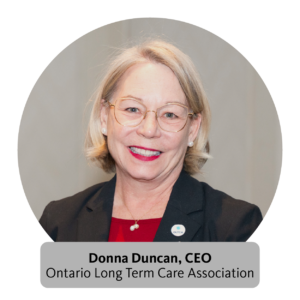
Donna Duncan is CEO of the Ontario Long Term Care Association.
*Jane Smith and Joe are pseudonyms.

Recently Added

November 16, 2026
Claudia Mahler: An Advocate for the Rights of Older Adults

October 20, 2026